The Tent in Three Acts
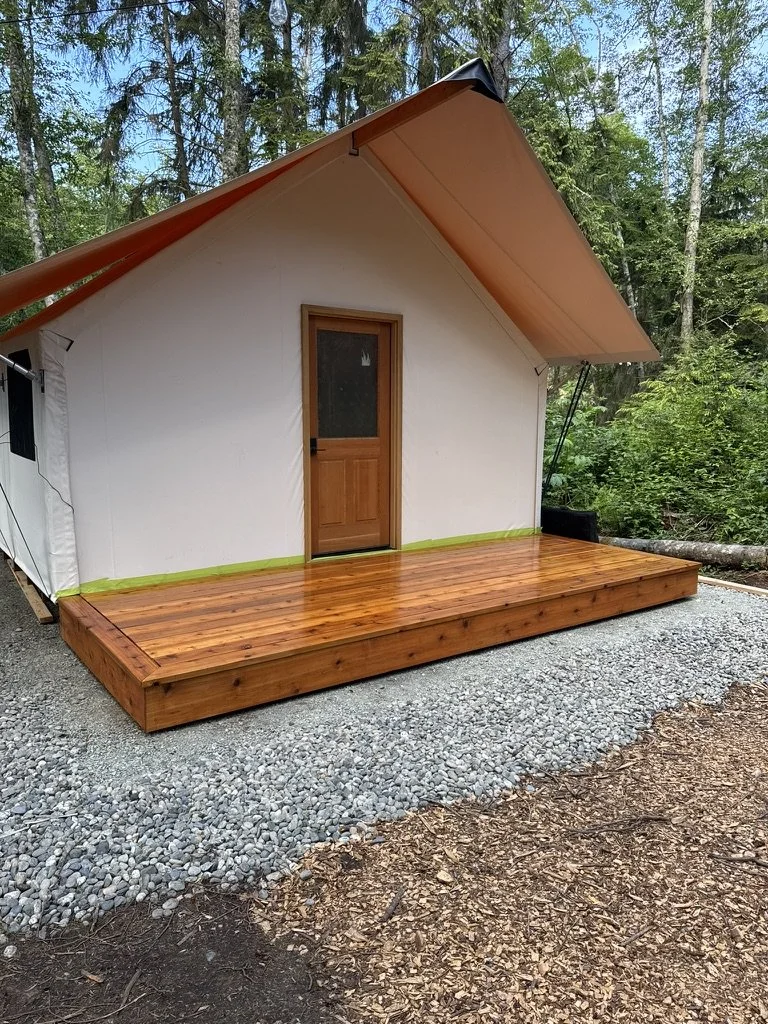
The tent was the first real thing we built.
Everything before it had been planning, drawing, paperwork, walking the property and pointing at where things would go. The tent was the first time we put stakes in the ground that meant something. By March, we couldn't wait any longer — we needed to be on this property, not just visit it. We needed somewhere to sleep when the days got long. We needed a fire and a roof and a door we could close.
We needed a tent. Specifically, we ordered a 16-by-16 canvas wall tent from Rainier Outdoor, built to spec with soft windows, a stove jack, and an upgraded wooden door. We had spent months researching. We had read every review. We had ordered the kit. The clock was ticking. The platform, on the other hand, did not exist yet.
That was Act One.
Act One: The Platform
We thought we could level the site ourselves.
We had bought gravel — six tons of it — delivered to one part of the property and meant for another. We had buckets. We had a wheelbarrow. We had ambition. What we did not have was an honest sense of how much six tons of gravel actually is, or how long it takes to move from one location to another with two people and the optimism of new landowners.
We hauled. We hauled some more. We compared the area we'd covered to the area we still needed to cover. We did some math. We hauled the rest. And when we were finally done — bodies aching, palms blistered, gravel dust in places gravel dust shouldn't go — we stepped back and realized it wasn't enough. The site still wasn't level. Not even close. We needed more material, and we needed someone with equipment and the experience to actually finish the grade.
We called in help.
Our first step was calling in a local crew of professionals. They came out, brought more gravel, brought their machines, and did in less than a day what would have taken us three more weekends. They handed the site back to us level, compacted, and ready. We thanked them, paid them, and called our friends.
Then…five of us showed up on a Saturday. We framed the platform out of pressure-treated lumber on cement blocks — sixteen feet by twenty-two, with a six-foot porch on the front. We did the entire build off-grid, powering every tool from the bed of a friend's F-150 Lightning. Saw, drill, sander, lights, charging station — all of it, all weekend, on the truck. It is one thing to plan an off-grid life. It is another to watch a building come together with no extension cords running to anywhere.
By Sunday evening, we had a deck.
Act Two: The Raising
We raised the tent the next weekend.
Same five friends. Same F-150 powering everything. The instructions made sense for about the first hour and then started to require interpretation. There were moments where three of us were holding a section of roof above our heads while two others tried to figure out which pole went where. There was at least one full reversal — a piece going on, coming off, going back on the right way. There was the particular comedy of trying to drape a heavy canvas fly over a structure when the canvas itself outweighs your tallest helper.
But it went up. It went up in a single weekend, which still feels like a small miracle. Canvas walls. Soft windows that roll up. A stove jack on one side. The wooden door — which, we should mention, is still not fully framed. It turns out that hanging a real door in a canvas wall is not intuitive in the ways you'd expect. We're working on it.
What we'll remember is the moment the canvas caught the light. The canvas glows from inside — the late-afternoon sun hits it from the west — an interior glow, almost honey, that makes the inside of a wall tent feel less like a building and more like a paper lantern with outlines of each tree branch visible from the inside. Each of us noticed. Five friends. Two homeowners. A floor that was still raw plywood. A door that wasn't complete. And a roof that was suddenly, against all odds, ours.
We built a real thing. Together. The "Greyhaven Builders Society" was born. We made merch. The club is not exclusive. Anyone willing to help is "in".
Act Three: The Stove
By late April, the furniture was in. All of it from IKEA, because IKEA is what you buy when you are furnishing a 256-square-foot canvas tent on five acres called Greyhaven. By early May, the porch was finished. By mid-May, we were taking long lunches on the bluff and disappearing into hammocks for afternoons at a time. The weather had turned. The Pacific Northwest was doing its rainshadow trick — sun, soft wind, the Olympics looking impossibly close.
The only thing left was the wood stove.
We installed it ourselves. This is the part where I should tell you that we are deeply qualified to install wood stoves in the soft canvas walls of structures we just built. We are not. We do not do HVAC. We do not do anything resembling HVAC. What we do is (try to) read instructions, watch videos, read more instructions, drive to the hardware store, drive back from the hardware store, drive to the hardware store again, and finally Frankenstein together a configuration that resembles what the manufacturer intended.
Our stove is from Davis Tent. It has a 5.5-inch flue (for reasons I don't understand). The stove jack on the side wall of our tent is closer to 6. We made it work with an adapter, three trips to two different hardware stores, several deliveries from Amazon, an alarming amount of high-temperature tape, and a great deal of looking at each other and saying I think this is right. We installed a carbon monoxide monitor. We installed a smoke detector. We tested everything twice.
When we lit the first fire, we both stood about ten feet away from the tent.
It worked. It drew clean. The tent stayed up. We did not burn down our first structure. We sat on the porch in mid-May with the door open and the stove crackling inside, and we were so proud of this slightly-wrong, slightly-improvised, completely-ours tent.
This is where we will live, weekend by weekend, until the Longhouse is real. We suspect this is where our guests will opt-in to stay even after the Longhouse is real, because we suspect glamping in a canvas wall tent in a quiet forest is a thing people will want to do. This is where the project finally became something we could be in, not just something we could draw.
We had been working on Greyhaven for six months. In those last weekends of spring, for the first time, Greyhaven felt like a place.
Build Notes
Platform
- Dimensions: 16′ × 22′ (16′ × 16′ tent footprint + 6′ front porch)
- Frame: pressure-treated 2×8 joists on 24″ centers
- Foundation: cement blocks, leveled and set on compacted gravel
- Decking: 3/4″ pressure-treated plywood, screwed to frame
- Floor finish: 3/4″ closed-cell foam underlayment + finished interior plywood on top (note: this looks beautiful and we already suspect it was a mistake. Forest floors are muddy and dirty. We will likely revisit this with something more washable.)
Site Prep
- ~4 yards of gravel (we hauled the first 6 tons ourselves; the leveling crew brought the rest and finished the grade)
- Local excavation crew handled final leveling and compaction. We'd estimate this saved us three weekends and prevented at least one platform-related disaster.
Tent
- Rainier Outdoor Canvas Cottage, 16′ × 16′
- Upgrades: soft (roll-up) windows, stove jack, 36″ wooden door
- Raising time: one weekend with 5 helpers
- Note: the wooden door installation is non-trivial in a canvas wall. Plan for additional framing work after the tent is up. Ours is not yet finished.
Wood Stove
- Davis Tent wood-burning camp stove
- Flue: 5.5″
- Our stove jack opening: ~6″ (larger than the flue)
- We bridged with an adapter and high-temperature sealant. Not the manufacturer's recommended configuration. We are aware. It is on the list.
- Required: carbon monoxide monitor + smoke detector. Non-negotiable. Install both.
Tools Used
- Circular saw, drill/driver, impact driver, level, framing square, speed square, measuring tape, sledgehammer (for cement blocks), wheelbarrow (for the gravel we hauled before we knew better)
Greyhaven Builders Society
- Founding crew, tent raising, May 2025
- Logo created and custom, insulated coffee mugs ordered through Yeti
- Membership open to those willing to swing a hammer and never take things too seriously. Coffee mug on us ;)
What We'd Do Differently
- Hire the leveling out from the start. The DIY hauling was character-building but cost us two weekends.
- Pick a stove with a flue size that matches a standard stove jack opening. Hire professionals to help with installation?
- Use a more durable interior floor finish than plywood. There may be a do-over in our future…
- Consider door framing and how it will integrate with flooring before raising the tent if possible.