The Treehouse, In Three Acts
The treehouse started with Josh.
Years before we owned this property, our friend Josh built a treehouse on his own land — a real one, off the floor and into the canopy, the kind of structure that was clearly more than a weekend project. Alex saw it, walked through it, climbed up into it, and filed something away. We didn't know yet that we'd eventually own five acres of forest. But the seed was planted in someone else's trees.
When we found Greyhaven, the treehouse was on the list from week one.
What we didn't know yet was how. Treehouses are not casual structures — they require an unusual combination of carpentry, rigging, arboriculture, and a tolerance for working at height. Most weekend builders don't attempt them. Most professionals who do are specialists. We were going to need a plan.
What we found was Treehouse Masters. Pete Nelson's book sat on our coffee table for months. Their Omak design caught us — a clean platform, a thoughtful pitched roof, a structure that felt at home in big trees rather than perched precariously on top of them. We weren't going to copy it, exactly. But it gave us a shape to think against. We ordered the structural hardware from Nelson — TABs (treehouse attachment bolts), brackets, all the engineered pieces — and started drawing.
The drawings began on the back of napkins.
There was a debate about how high to set the platform. Eight feet? Ten? Twelve? We landed on ten — high enough to feel committed, low enough that a ladder is still reasonable. There was a debate about which direction the structure should face — toward the bluff, or angled to catch the southwest light. We picked the bluff. There was the longest debate, which was about whether to build the deck on the ground and then hoist it into place, or build it in the air. We picked the air. We were determined to do everything as amateurs but we agreed to one exception: if a crane was required, we would call the crane.
The Greyhaven Builders Society reconvened at the end of May.
Act One: The Plan
The Society — same crew as the tent raising, plus a few rotating drop-ins — pulled up to the property in late May with the F-150 Lightning, several tarps, an alarming amount of structural hardware, and our drawings refined into something resembling a real plan. The trees were already chosen. They had been chosen back in February, when the arborist confirmed that the spruce and the hemlock at the southwest edge of the property were perfect — the best seats in the house, he had called them.
The plan was to work in stages. Stage one: rig the trees, install the TABs (the structural bolts that are the foundation of every Nelson treehouse), and raise the yokes — the cross-beam assemblies that span between the two trees and carry the platform load. Stage two: lift the giant glulam beams that would sit atop the yokes. Stage three: frame and deck the platform itself. We had the summer.
The first weekend was rigging and inserting the TABs. We learned how to use a come-along. We learned how the trees move in wind. And we were really high up.
Act Two: Connecting the Trees
We raised the yokes — each yoke is twelve feet across and sits ten feet off the ground. We calculated the weight at roughly six hundred pounds each. We raised them by hand — the Society, four come-alongs, the F-150, and a great deal of yelling between people standing on ladders and people standing on the ground. We got both yokes level, which felt like a small miracle and turned out to be only the beginning of the harder problem.
The harder problem was the eastern tree was not perfectly parallel to the western tree. When we went to align the second yoke against the geometry the first one had established, we discovered that the connection point on the eastern TAB was several degrees off. Not by much. Enough.
We had to go back to the drawing board.
This is where Nelson became more than a parts supplier. Alex called them. They walked him through the geometry. They specified the new bracket configuration that would let the yoke flex through the off-axis connection. He drove down to pick up the new hardware in person — he could have had it shipped, but he wanted to be there. They gave him a tour of the production facility while he was at it. He came back with hardware and stories and the kind of quiet enthusiasm that comes from spending an afternoon with people who care about the same weird thing you care about.
The new hardware solved the problem.
Then there were the beams. The glulams that sit atop the yokes are fourteen feet long and twelve inches tall — engineered laminated timber, beautiful, heavy, and well past anything two people with come-alongs could realistically lift to ten feet of elevation. This was our crane moment. We called the local guy who had done the leveling for the tent platform, who has the equipment and the patience for jobs like this, and he raised the beams in an afternoon. We watched. We thanked him. Then we got back to work.
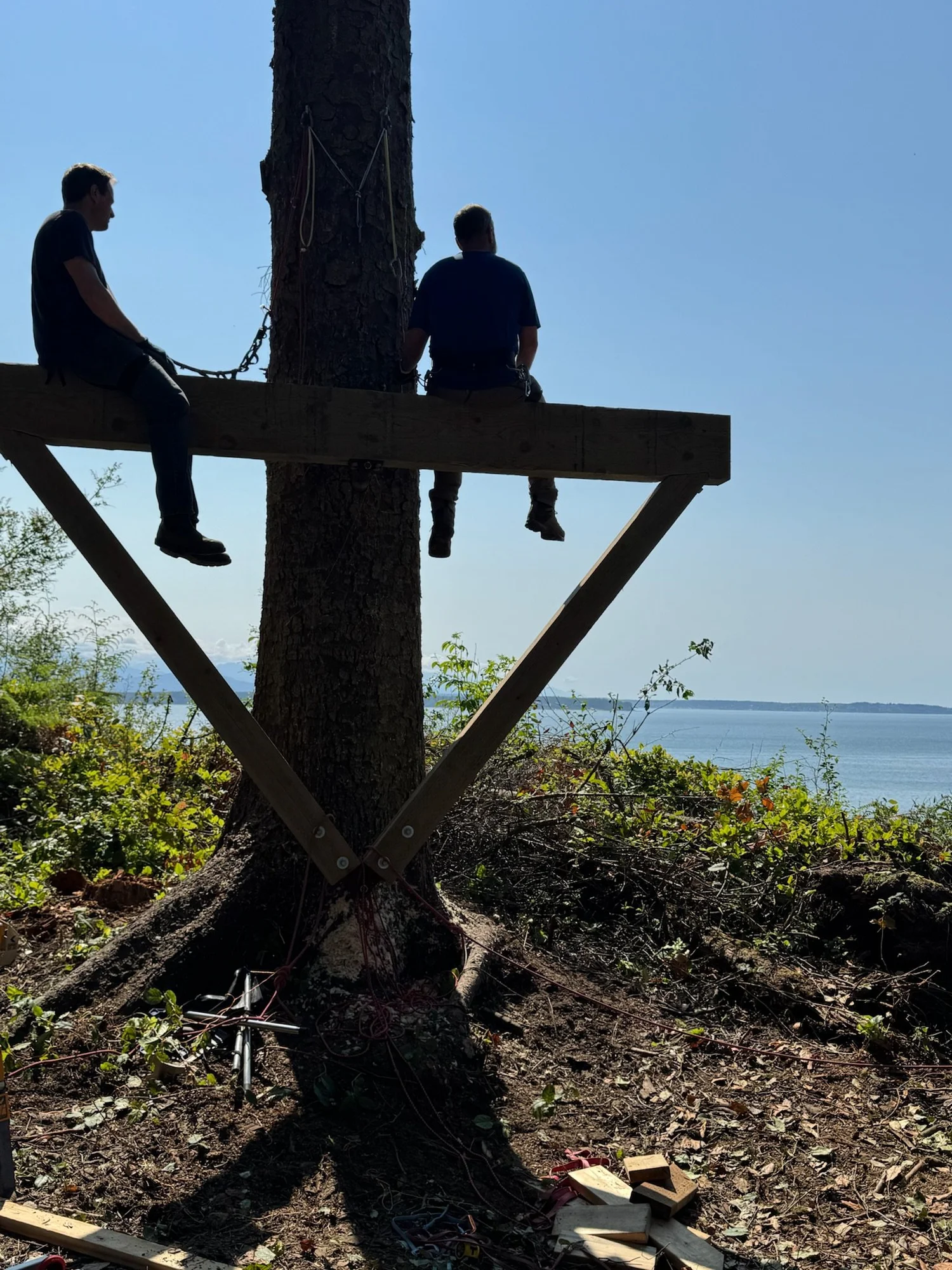
When the second yoke was finally level, with the new hardware seated cleanly and the giant beams resting where they belonged, Josh and I climbed up and sat on them.
That was the moment.
Ten feet up, between two enormous trees, with the Olympics across the water and the Admiralty Inlet shining below. The yokes held. The beams held. We had built the structural skeleton of a treehouse with our hands and a lot of hardware and one very good supplier and the help of one very patient professional. We sat there for a long time, our legs hanging off the edge, not saying much.
Some accomplishments are quiet.
Act Three: The Platform
Framing started at the end of July.
By that point the structural work was done — the trees were connected, the yokes were level, the beams were in. What remained was the carpentry we already knew how to do. The Society reconvened. We framed a deck across the beams. We installed blocking. We screwed down decking boards one at a time, working out from the center, learning the small annoyances of building a square structure between two trees that have their own ideas about geometry.
By the end of August, the platform was done.
We leaned a ladder against the side. We hauled up two camp chairs and a bottle of wine. We sat ten feet off the ground, between two trees we had marked back in February, on a deck we had built across the summer, and watched the sun set over the Olympics. The light went pink, then gold, then the kind of deep blue that settles into the inlet just before dark. We didn't say much. We didn't need to.
The treehouse is not finished. The deck is the deck — there is still a roof to build, walls to frame, the salvaged spruce and hemlock siding to apply once it's done drying. We're going to give the wood the shou sugi ban treatment when it's ready: the Japanese technique of finishing wood with a torch, charring the surface to seal and weatherproof it. The boards that came off this property in February will eventually wrap the structure built between two of its remaining trees, blackened by fire, weather-resistant for decades.
We've paused for now. The weather is turning. The longhouse and the art studio are heading into permitting, and we don't want construction on the treehouse to complicate the paperwork. The platform will sit through the winter, gathering moss and the occasional dusting of snow, waiting for us to come back to it next spring.
But it's there. Ten feet up. Between the spruce and the hemlock. The skeleton of something we'll keep building for years.
The arborist was right. They are the best seats in the house.
Build Notes
A practical appendix for anyone trying to do the same thing.
Inspiration
- Treehouse Masters / Nelson Treehouse, specifically the Omak design from Pete Nelson's book
Structural hardware (all from Nelson)
- TABs (treehouse attachment bolts) — 4
- Custom brackets and hardware for off-parallel tree alignment
- Yoke assemblies, brackets, anchors
Trees
- Spruce + hemlock pair, southwest edge of property
- Selected by certified arborist
- Trees are not perfectly parallel — required custom hardware
Yokes
- 12 feet across, 10 feet off the ground
- ~600 lbs each
- Raised by hand using come-alongs
Glulam beams
- 14 feet long, 12 inches tall
- Engineered laminated timber
- Raised by a local crew with a lift; this was beyond our capacity
Platform
- Framing started July 26, 2025
- Decking completed end of August 2025
- Roof, walls, and siding still pending
Future siding
- Salvaged spruce and hemlock from the property's milling project
- Will be finished using shou sugi ban — Japanese torch-finishing technique
- Currently drying
What we'd do differently
- Verify tree-to-tree alignment angles before ordering hardware. The "trees are basically parallel" assumption is not safe.
- Plan the crane day from the start. The glulams were never going to be a hand-raise.